

Picture a busy contact center at a major e-commerce platform during peak holiday season. Support agents handle thousands of customer queries daily: tracking orders, resolving shipping issues, managing returns. The bottleneck is not the agents themselves. It is the time lost hunting through fragmented knowledge resources mid-call.
Agent assist software is an AI-powered solution built for exactly this scenario. It gives human agents real-time guidance, instant knowledge retrieval, and automated post-call summaries, without interrupting the conversation. According to Kayako, AI tools helped reduce average handling time (AHT) by nearly 25% in early 2025 by automating routine steps and surfacing answers during live calls. Lower AHT translates directly into higher customer satisfaction scores.
This article covers how agent assist software works, what separates the leading platforms, and how to choose the right AI agent for customer service in your organization.
What Is an AI Agent?
AI agents are intelligent, autonomous software systems capable of perceiving their environment, processing data, and taking actions to achieve specific goals. Unlike traditional rule-based chatbots, AI agents use advanced generative models to reason, plan multi-step tasks, and adapt dynamically to new inputs.
In a business context, an AI agent can analyze incoming customer queries, retrieve information from large knowledge bases, and execute workflows — booking appointments, routing tickets, or escalating complex cases to human specialists: all without manual intervention.
The core characteristics of AI agents include:
- Autonomy. They operate independently and improve over time through interaction data.
- Generative capabilities. They produce human-like responses, summaries, and content tailored to user context and preferences.
- Integration potential. AI agents connect with cloud platforms, CRMs, APIs, and enterprise tools within existing tech stacks.
For customer service, AI agents are the foundation of agent assist solutions, enabling proactive support that reduces response times and lets human agents focus on complex, high-value interactions.
What Is Agent Assist Software?
Agent assist software is a specialized category of AI-powered platforms built to support human agents in contact centers, help desks, and customer support teams. It functions as a co-pilot: providing live guidance during calls and chats, pulling relevant information from knowledge resources and customer histories, and generating suggested responses, all in real time.
The core value proposition is combining automation with human judgment. Rather than replacing agents, these tools handle the lookup and drafting work so agents can focus on the conversation itself. This is particularly valuable in high-volume environments like e-commerce, telecom, or financial services, where resolution speed is a direct factor in customer retention.
The three immediate capabilities that drive adoption:
- Instant knowledge access. Surfaces order details, product specs, and policy information during live interactions without the agent leaving the call.
- Live response suggestions. Generates contextually accurate reply drafts during simultaneous customer conversations across channels.
- Automated interaction summaries. Captures key details and action items at the end of each call, reducing wrap-up time significantly.
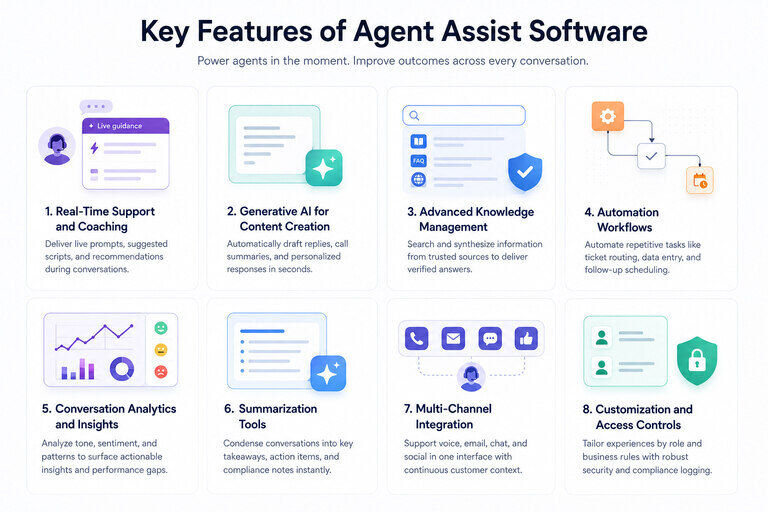
Key Features of Agent Assist Software
Modern agent assist platforms share a common feature set, though depth and implementation vary by vendor. Here are the capabilities that matter most in practice:
Real-Time Support and Coaching
Delivers live prompts, suggested scripts, and recommendations during customer conversations. Helps agents navigate complex queries confidently without putting customers on hold.
Generative AI for Content Creation
Automatically drafts email replies, call summaries, and personalized responses based on conversation context and customer history. Reduces the time agents spend composing from scratch.
Advanced Knowledge Management
Searches and synthesizes information from internal wikis, FAQs, and external resources during active conversations. Agents get verified answers rather than guesses.
Automation Workflows
Handles repetitive tasks like ticket routing, data entry, and follow-up scheduling, freeing agents for interactions that require judgment and empathy.
Conversation Analytics and Insights
Analyzes tone, sentiment, and patterns across calls and chats. Surfaces actionable business intelligence — common pain points, phrases that resolve calls fastest, and agent performance gaps.
Summarization Tools
Condenses long interactions into key takeaways, action items, and compliance notes in seconds. Reduces post-call wrap-up time and improves case documentation accuracy.
Multi-Channel Integration
Supports voice, email, chat, and social media in a unified interface, ensuring consistent agent experience and customer data continuity across touchpoints.
Customization and Access Controls
Allows tailoring to agent roles, business rules, and customer segments. Enterprise deployments typically add role-based access controls and compliance logging for regulated industries.
Top Agent Assist Solutions
The agent assist market has several standout platforms, each strongest in a specific area. Here is a side-by-side overview:
| Platform | Key Strengths | Best For |
| Gong | Conversation intelligence, real-time coaching, advanced analytics | Sales and support teams needing call insights |
| Zendesk AI | Generative responses, knowledge base integration, automation | Mid-sized contact centers focused on multi-channel support |
| Intercom | Live chat assist, customer messaging, personalization | E-commerce and SaaS businesses prioritizing proactive engagement |
| Chorus.ai | Call summarization, sentiment analysis, productivity metrics | High-volume call centers with analytics needs |
| Google Dialogflow / AWS Connect | Cloud scalability, custom AI agents, deep integrations | Large enterprises building bespoke solutions |
Most of these platforms offer free demos and detailed case studies. Evaluate them against your existing tech stack, call volume, and CRM before committing.
How to Choose the Right Agent Assist Software
The right platform depends on your specific operations, not on vendor rankings. A structured evaluation process prevents costly mismatches:
- Assess your pain points first. Map where time is actually lost — high call volumes, knowledge gaps, long wrap-up times, or inconsistent agent quality.
- Test core capabilities in a demo. Run generative AI, live assist tools, analytics, and automation against real scenarios from your support queue, not vendor-prepared scripts.
- Check integrations. Confirm compatibility with your CRM (Salesforce, HubSpot), cloud services (AWS, Azure, Google Cloud), and knowledge management systems.
- Review security and compliance. Prioritize platforms with data encryption, GDPR support, audit trails, and — for regulated industries — SOC 2 or HIPAA certification.
- Analyze ROI with real benchmarks. Look for case studies from companies similar in size and industry, not just headline metrics from the vendor’s homepage.
- Evaluate scalability and support. Opt for solutions with flexible pricing tiers, documented onboarding, and accessible technical support as your team grows.
- Run a pilot before full rollout. Deploy with one team or one channel first. Measure AHT, first-contact resolution, and agent satisfaction before expanding.
Most of the leading agent assist tools offer free 14-day trials. Start with the platform that most closely fits your CRM and see how it performs on your actual call types.
Conclusion
Agent assist software has moved from a niche tool to a standard part of enterprise contact center infrastructure. The combination of real-time knowledge retrieval, generative AI, and conversation analytics gives support teams a measurable edge: shorter handling times, more consistent responses, and better data for continuous improvement.
The platforms differ significantly in depth, integration options, and pricing. The right choice depends on your call volume, existing tech stack, and whether your priority is coaching, automation, or analytics. Start with a free demo on the platforms listed above, run a pilot on one channel, and measure results before scaling.
Good luck with your technical writing!
Author, host and deliver documentation across platforms and devices
FAQ
What is the main benefit of agent assist software for customer service?
The primary operational benefit is reduced handling time. Real-time AI guidance lets agents resolve queries faster without escalating or searching manually — which directly improves first-contact resolution rates and customer satisfaction scores.
How does generative AI enhance agent assist platforms?
Generative AI powers conversation summarization, personalized response drafting, and predictive insights. Rather than retrieving a static FAQ answer, it synthesizes a contextually accurate reply based on the specific customer’s history and the current conversation.
Can agent assist tools integrate with existing cloud services?
Yes. Leading platforms integrate with AWS, Google Cloud, and Microsoft Azure, as well as tools like Salesforce, Slack, and Zendesk. Most offer pre-built connectors for common CRMs and ticketing systems.
Is agent assist software suitable for small businesses?
Yes. Cloud-based options like Intercom and Zendesk AI scale from small support teams upward, with pricing tiers that don’t require heavy IT infrastructure. The quick wins in automation and response consistency are often more impactful at smaller scale, where each agent handles a wider variety of query types.
How to build an AI agent assist workflow from scratch?
Start by mapping your top 20% of query types by volume. Choose a platform with strong knowledge base integration. Connect it to your CRM and existing documentation. Run a pilot on one channel (chat or email), measure AHT and first-contact resolution, then expand. Most platforms provide onboarding resources and professional services to accelerate setup.
What role does analytics play in agent assist?
Analytics close the feedback loop. They identify which query types take longest to resolve, which scripts work best, and where agents consistently struggle — giving managers concrete data to improve both training and documentation rather than relying on anecdotal feedback.