
Ever wondered why some texts feel effortlessly clear while others leave you scrambling for a dictionary?
The secret often lies in readability—and formulas like the Flesch Reading Ease Formula are the keys to unlocking it.
In this guide, we’ll break down how these formulas work, why they matter, and how to use them to connect with your audience—no advanced degree required.
Let’s dive in!
What Is the Flesch Reading Ease Score?
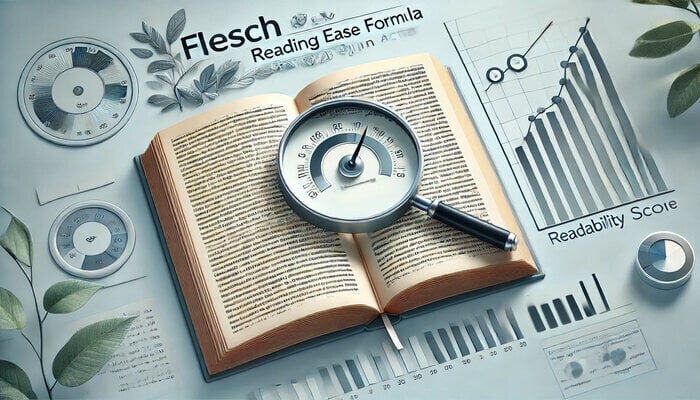
The Flesch Reading Ease Score is a readability formula developed by Rudolf Flesch in 1975. It measures how easy or difficult a text is to understand based on average sentence length and average syllables per word. Ranging from 0–100, higher scores mean simpler content, while lower scores indicate more complex writing.
Why Does the Flesch Score Matter?
By pairing the Flesch score with the Flesch-Kincaid Grade Level, you can fine-tune content for specific audiences—whether you’re writing for 5th graders or PhDs. In short, it’s about meeting readers where they are.
The Flesch Reading Ease Formula
The formula uses two variables:
- Average sentence length (ASL): the number of words divided by the number of sentences.
- Average syllables per word (ASW): the number of syllables divided by the number of words
Flesch Reading Ease = 206.835 – (1.015 × ASL) – (84.6 × ASW)
- ASL = Average Sentence Length (words per sentence).
- ASW = Average Syllables per Word.
Example:
For a text with 15 words per sentence and 1.5 syllables per word:
206.835 – (1.015 × 15) – (84.6 × 1.5) = 206.835 – 15.225 – 126.9 = 64.71
What Does Your Flesch Score Mean?
The higher your score is, the easier it is to understand by the audience.
| Score | Readability Level | Grade Level | Example Texts |
| 90–100 | Very Easy | 5th grade | Children’s books |
| 70–89 | Easy | 6th–8th grade | Blogs, news articles |
| 60–69 | Plain English | High school | Popular novels |
| 50–59 | Fairly Difficult | College | Academic journals |
| 30–49 | Difficult | University | Technical manuals |
| 0–29 | Very Confusing | Graduate level | Legal contracts |
Ideal scores:
- General public: Aim for 60-70.
- Academic papers: 30-50 is appropriate.
- Technical documentation: 40-60 may be suitable.
- Legal documents: Traditional scores are 10-30, but many advocate for higher scores.
How to Calculate Your Flesch Score Manually?
- Count total sentences, words, and syllables in your text.
- Calculate ASL: Total Words / Total Sentences.
- Calculate ASW: Total Syllables / Total Words.
- Plug values into the formula.
Tools like ClickHelp offer the built-in readability statistics features often, or you can always use a specific calculator.
How to Improve Your Flesch Reading Ease Score?
- Shorten sentences. Aim for 15–20 words per sentence.
- Use simpler words. Replace long terms with shorter synonyms (e.g., “utilize” → “use”).
- Avoid jargon. Explain technical terms or use everyday language wherever possible.
- Break up paragraphs. Use subheadings and bullet points.
- Test readability.
Pro Tip: Pair the Flesch score with the Flesch-Kincaid Grade Level formula for a complete readability analysis.
Flesch Reading Ease vs. Other Readability Formulas
| Formula | Focus | Best For | Scale/Measurement |
| Flesch Reading Ease | Syllables, sentence length | General readability | 0-100 (higher = easier) |
| Flesch-Kincaid Grade | Syllables, sentence length | Education materials | U.S. grade level |
| Coleman-Liau Index | Characters per word, not syllables | Automated analysis, English texts | U.S. grade level |
| Dale-Chall | Familiar word lists | Adult literacy | U.S. grade level |
| Gunning Fog | Complex words (3+ syllables) | Technical documents | U.S. grade level |
FAQs About the Flesch Score
Q: What’s the difference between Flesch Reading Ease and Flesch-Kincaid?
A: Flesch Reading Ease gives a 0–100 score, while Flesch-Kincaid converts it to a U.S. grade level.
Q: Why does my blog post have a low score?
A: Long sentences and complex terms (e.g., “algorithmic optimization”) lower your score. Simplify whenever possible!
Q: Do all industries prioritize the same Flesch score?
A: No! Healthcare and government aim for 80+ for accessibility, while academic texts may target 30–50.
Conclusion
The Flesch Reading Ease Formula is one of the ways for cutting through the noise. A litmus test for your content: Are you speaking to your audience or past them?
Ready to turn complexity into connection with ClickHelp? Start a free trial or book a demo.
Good luck with your technical writing!
ClickHelp Team
Author, host and deliver documentation across platforms and devices