
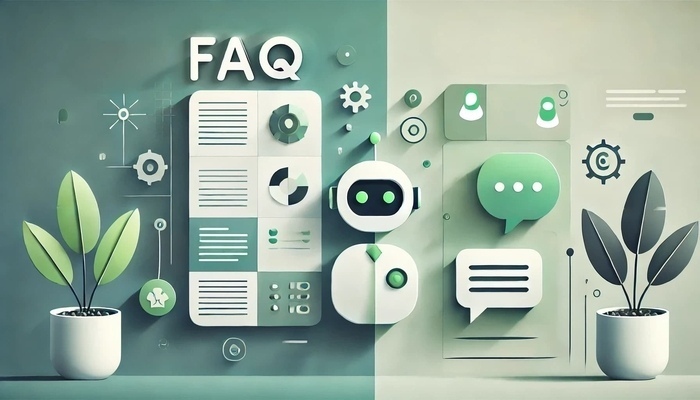
Today, delivering excellent customer support is essential for business success. Customers expect quick, accurate answers to their questions, and companies are continually searching for the most efficient and cost-effective ways to meet these demands. Two popular solutions for handling customer inquiries are FAQ (Frequently Asked Questions) systems and AI-powered chatbots. While both aim to streamline the support process, they differ significantly in their capabilities and overall impact. So, which one represents the future of customer support?
The Traditional Approach: FAQ Systems
FAQ systems have been a cornerstone of online customer support for years. They consist of a predefined list of common questions and answers, usually organized by category and searchable by keywords.
Advantages
- Cost-effective: FAQs are relatively inexpensive to create and maintain. While initial setup requires effort, ongoing costs are low since updates are only needed periodically.
- Easy to implement: Many CMS platforms and website builders include built-in FAQ features or plugins, making setup straightforward.
- Immediate answers: Customers can quickly find responses to common questions without waiting for a live agent.
- Consistent messaging: FAQs ensure all customers receive the same accurate information, reducing miscommunication.
- Reduces agent workload: By handling frequent inquiries, FAQs free up support staff to focus on more complex issues.
It’s important to note that a chatbot still relies on this foundational knowledge—FAQs or a knowledge base—to provide useful answers. Without a well-maintained set of questions and answers created or curated by a support team, chatbots lack valuable data to function effectively. You can build a good bot from years of accumulated customer support knowledge, but starting from scratch with a bot is unlikely to yield quality results.
Disadvantages
- Static and inflexible: FAQs are limited to predefined content and cannot handle new or nuanced questions outside their scope.
- Limited search capabilities: Users may struggle to find relevant answers if they don’t use keywords matching the FAQ’s wording.
- Impersonal: FAQs lack the human touch and cannot offer personalized assistance based on individual needs.
- Maintenance challenges: Keeping FAQs up-to-date requires ongoing effort, especially as products, services, or policies change. Outdated information can frustrate customers and harm credibility.
- No learning or adaptation: FAQ systems remain unchanged unless manually updated, so they do not improve over time or adapt to evolving user needs.
The Rise of AI Chatbots
AI-powered chatbots represent a significant advancement in customer support. These bots use natural language processing (NLP) and machine learning (ML) to understand customer inquiries and provide relevant responses in real-time.
Advantages
- 24/7 availability: Chatbots can offer instant support around the clock, even outside regular business hours.
- Personalized support: AI can analyze customer data to deliver tailored recommendations and solutions.
- Handles complex inquiries: Chatbots can interpret nuanced language and complex questions, providing more relevant and accurate responses than traditional FAQs.
- Learns and adapts: Through machine learning, chatbots continuously improve their ability to understand and respond to customer needs.
- Scalable: Chatbots can manage a large volume of inquiries simultaneously without requiring additional staff.
- Proactive support: Some chatbots can initiate interactions based on customer behavior or browsing history, offering help before it’s requested.
- Data collection and analysis: Chatbots gather valuable insights on customer needs and pain points, helping improve products, services, and overall experience.
Disadvantages (or Why People Often Dislike AI Bots)
Many users find AI chatbots frustrating. For example, a banking chatbot might fail to understand simple requests, such as asking for a card replacement but instead suggesting mortgage appointments. After repeated misunderstandings, the system usually transfers the customer to a human agent.
Customer satisfaction is a crucial KPI, as dissatisfied customers tend to switch providers. Despite frustrations, chatbots effectively filter out many routine inquiries, freeing human agents to focus on complex issues.
Common chatbot conversations can sometimes feel circular or unhelpful:
“Someone canceled my internet.”
“You want to cancel your internet? Here’s how.”
“No, someone canceled my current plan.”
“We’re sorry you want to cancel.”
This has led to a cynical view that chatbots are a way for companies to avoid human interaction and neglect their customers. However, a more balanced perspective suggests people would accept bots if they were more sophisticated—like those powered by advanced large language models (LLMs) such as ChatGPT—rather than rigid, rule-based systems with limited responses.
Most current chatbots rely on NLP combined with preconfigured rules, limiting their flexibility and understanding. Only a few advanced bots are built on LLMs capable of more natural and dynamic conversations.
Summary of AI Chatbot Disadvantages
- Higher initial cost: Developing and deploying AI chatbots is generally more expensive than creating FAQ systems.
- Requires technical expertise: Setting up and maintaining chatbots involves specialized skills in NLP and machine learning.
- Potential for errors: Chatbots can still misunderstand complex or ambiguous queries, though they improve over time.
- Can feel impersonal: Early chatbot interactions may come across as robotic or scripted, although AI advancements are making conversations more natural.
- Security concerns: Handling sensitive customer data requires stringent security measures to protect privacy.
Enhancing Support with AI-Driven Documentation: The Case of AnswerGenius
One innovative example of how AI can complement traditional FAQs and chatbots is AnswerGenius — an AI-powered assistant from ClickHelp embedded directly within your documentation portal. Rather than relying on simple keyword searches, AnswerGenius reads and understands the context of user questions, delivering precise, natural language answers based on your existing content.
Here’s how it works: when a user types a question into the chat widget (usually located in the bottom-right corner), AnswerGenius scans your published documentation, identifies the most relevant topics, and generates a clear, contextual response. It also provides links to full articles for users who want more detailed information.
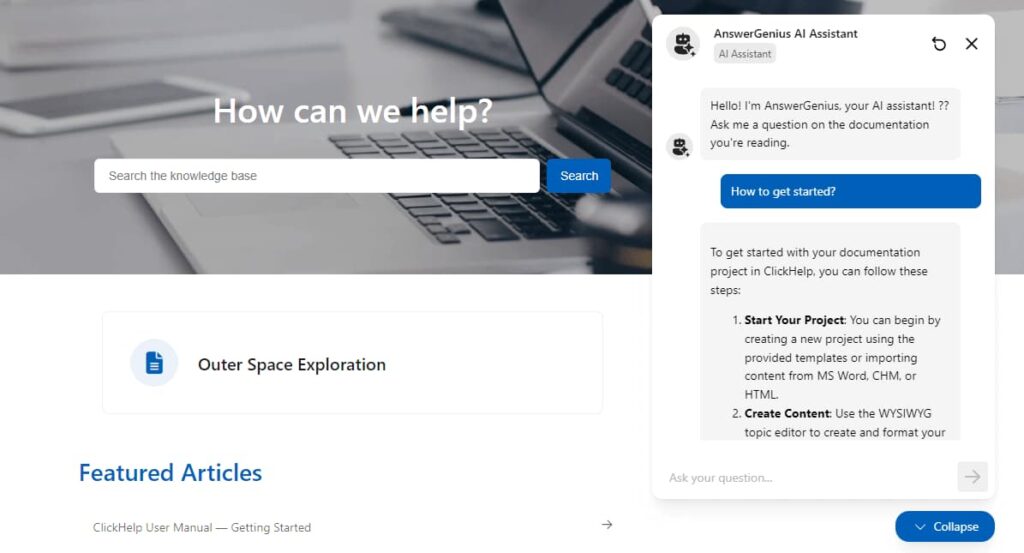
What makes AnswerGenius particularly appealing is that it requires zero setup or training—there’s no need for manual tagging or additional configuration. It can be enabled on both public and password-protected documentation portals, making it a versatile solution for many businesses.
By leveraging AnswerGenius, companies can reduce repetitive support requests, improve user experience with fast, conversational responses, and increase content discoverability—especially on mobile devices or when users are short on time. The AI also adapts to the language of your portal, enhancing accessibility for global audiences, with additional language support planned for the future.
Integrating ClickHelp’s AnswerGenius into your customer support ecosystem showcases how AI can effectively bridge the gap between static FAQs and interactive chatbots, delivering a more seamless and efficient experience for your users.

The Future: A Hybrid Approach?
There is a common belief that AI will never fully replace human customer support agents, and here are three reasons why:
- Humans prefer to talk to other humans. When an AI bot says, “I understand your problem,” or “I feel bad for what you went through,” it doesn’t truly comfort the customer because we know the AI has no emotions. The same words coming from a human have a completely different impact.
- The real world is complex and unpredictable. AI performs well only within the scope of the data and scenarios it has been trained on. However, customers often face unique situations that weren’t anticipated, which interacting with AI can sometimes worsen by increasing frustration.
- AI bots understand scenarios but cannot manage real-life complexities. For example, if you place an order with a major food delivery app and see that the delivery driver hasn’t moved on the map, you know your order will be late. But if you ask the AI agent, “Where is my order?” and it replies, “Your order is on time; there are still 5 minutes left,” it can cause real frustration.
So, what does the future of customer support look like? While AI chatbots offer clear benefits in personalization, scalability, and learning capabilities, FAQ systems still play a valuable role.
The most effective solution may be a hybrid approach that combines the strengths of both. The best customer support teams will integrate AI and human agents, where straightforward issues are handled by AI, and more complex cases are escalated to humans.
A chatbot can manage initial inquiries and provide instant answers by leveraging a knowledge base of FAQs. When it encounters a complex or nuanced problem, it can smoothly transfer the conversation to a human agent.
It’s generally recommended to use bots for basic tasks like order tracking and common questions, while ensuring customers can easily reach a human when needed. Nothing is more frustrating than getting stuck in an endless bot loop during a real problem. Transparency is also key—companies should clearly disclose when a customer is interacting with a bot rather than trying to pass it off as human, as customers appreciate honesty.
A hybrid approach offers the best of both worlds: the speed and efficiency of AI chatbots combined with the empathy and expertise of human agents.
Conclusion
AI chatbots are undeniably transforming customer support by enabling businesses to deliver faster, more personalized, and efficient service. However, FAQ systems continue to be valuable for handling common inquiries and easing the burden on support teams. The future of customer support likely lies in a hybrid approach that combines the strengths of both, creating a seamless and satisfying experience for customers. Companies that adopt this hybrid model will be well-positioned to succeed in the increasingly competitive digital landscape.
Good luck with your technical writing!
Author, host and deliver documentation across platforms and devices
FAQ
Can AI chatbots fully replace FAQ systems?
Not entirely. While AI chatbots offer dynamic, conversational support and can handle complex inquiries, FAQ systems remain invaluable for providing clear, consistent answers to common questions. The best customer support strategy often combines both.
How do AI chatbots learn to answer customer questions?
AI chatbots use natural language processing and machine learning to understand and respond to queries. They rely on existing data, including FAQs, knowledge bases, and past interactions, to improve their accuracy over time.
Are AI chatbots expensive to implement?
AI chatbots generally require a higher upfront investment than FAQ systems due to development, setup, and ongoing maintenance. However, their ability to handle many simultaneous interactions can reduce overall support costs in the long run.
What if my chatbot can’t answer a customer’s question?
A well-designed hybrid system will escalate complex or unresolved issues to human agents, ensuring customers get the help they need without frustration.
How can I ensure my customers don’t get stuck in a chatbot loop?
Make sure your chatbot clearly offers an option to speak to a human agent at any point. Transparency about when users are interacting with a bot, rather than a human, also helps manage expectations and improve satisfaction.
How does AnswerGenius by ClickHelp improve the customer support experience?
AnswerGenius uses AI to understand user questions contextually within your documentation and provides immediate, conversational answers. It reduces repetitive inquiries and enhances content discoverability without any setup or training needed.