

A product onboarding process is essential for SaaS and technical software products. It guides users from initial signup to full mastery of the product. In competitive industries like SaaS and technical documentation tools, onboarding directly affects activation rates and long-term retention by addressing user pain points early.
For example, Intercom experienced early churn as new users struggled with dashboard complexity. By introducing personalized checklists and in-app video prompts, they reduced drop-offs by 30%, accelerating team adoption.
This illustrates why onboarding is not just a nice-to-have—it is central to activation, retention, and long-term product success.
What Is Product Onboarding
Product onboarding is more than just a welcome message or a tutorial. It is a carefully structured sequence of interactions that guides a user from initial setup to achieving their first meaningful success within the product. In technical sectors, onboarding often includes account creation, feature discovery, workflow integration, and the first successful use case.
The key outcome of onboarding is reducing the time-to-competency – the time it takes a user to become independently proficient in essential tasks. For technical tools like documentation platforms, this could mean going from first login to publishing a multi-format document in a fraction of the time it used to take. Industry-specific onboarding enhances this process by embedding domain terminology, regulatory requirements, and workflow integrations directly into the onboarding experience. As a result, users can focus on their real work rather than figuring out the software.
Why Onboarding Matters
In SaaS, first impressions matter. Users who experience immediate value are more likely to continue using the product, upgrade to premium plans, and recommend it to peers. Data shows that optimized onboarding flows can increase activation from 25–40% to 50–60%.
Similarly, providing clear onboarding reduces support tickets and fosters loyalty; 86% of users are more likely to stay if onboarding and ongoing education are offeredю
This is particularly important for technical software. A documentation tool user who understands snippet management, DITA standards, or API integrations from the start will not only adopt the software faster but will also integrate it seamlessly into daily workflows, making them an advocate for the product.
How Onboarding Works in Practice
Effective onboarding is built around clear objectives and an understanding of your users. Teams often start by mapping user personas – for example, technical writers handling multilingual exports or project managers coordinating complex workflows. Once the personas are defined, measurable goals such as completing initial setup within 10 minutes or publishing the first template in five steps help track progress.
Cross-functional collaboration is crucial. Product managers, UX designers, domain experts, and customer success specialists need to work together to identify friction points. Workshops simulating real user journeys reveal challenges such as data imports, API authentication, or review cycles. Using analytics, teams can monitor where users drop off and adjust onboarding flows iteratively.
Interactive Tours
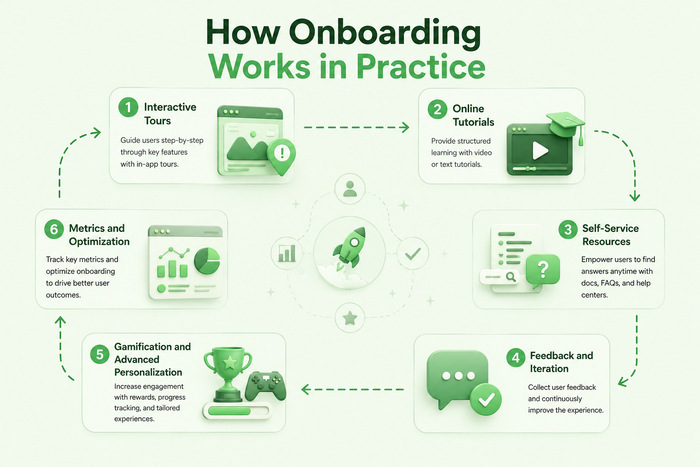
Interactive tours guide users through key features and workflows while adapting dynamically to their roles:
- Dynamic personalization: Tours adjust content and sequence based on detected user roles (e.g., developer vs. manager), boosting completion rates to 82%.
- Pause/resume functionality: Users can interrupt and resume tours during real-world deployment cycles.
- Progressive guidance: Focused, step-by-step instructions minimize cognitive overload while respecting the user’s pace.
This approach ensures high engagement and helps users achieve early success without frustration.
Online Tutorials
Online tutorials provide structured, linear guidance for mastering complex SaaS workflows. For platforms like ClickHelp, tutorials support tasks such as authoring documentation, managing versioning, or publishing multi-format outputsю
Key features include:
- Sequential Navigation: Next/Previous buttons guide users through ordered steps, preventing overwhelm.
- Multimedia Integration: Screenshots, annotated videos, and diagrams provide context and highlight UI elements.
- App-Embedded Delivery: Contextual overlays reduce context-switching and keep users productive.
- Pause/Resume: Tutorials can be interrupted and resumed according to real-world workflows.
- Safe Hands-On Practice: Simulations allow practice with complex tasks like API scripting or documentation assembly without live system risks.
By combining these elements, online tutorials reduce learning curves, lower support demands, and increase onboarding completion rates.
Self-Service Resources
Self-service resources empower users to solve problems independently and reinforce learning:
- Guides and demos: Step-by-step workflows, interactive simulations, and video tutorials for risk-free practice.
- Dynamic FAQs: NLP-powered search answers questions like “troubleshoot snippet versioning errors.”
- Writer tools: Templates for standards like DITA or Markdown, searchable glossaries, multilingual support, and mobile optimization.
These resources streamline onboarding while reducing the burden on support teams.
Feedback and Iteration
Continuous feedback ensures onboarding stays effective:
- NPS pulses: Quick surveys after key milestones (e.g., first project publish).
- Session replay and heatmaps: Identify hesitation points in complex workflows.
- Role-based segmentation: Tailor improvements for writers, reviewers, or managers.
- Personalized updates: Inform users of fixes or new features based on their input.
By integrating user insights, companies can refine onboarding and reduce support tickets over time.
Gamification and Advanced Personalization
Engaging users through gamification and personalization boosts adoption:
- Gamification: Progress trackers, achievement badges, and leaderboards increase feature adoption; quizzes reinforce learning. Example: “Complete 3 topics to unlock advanced formatting” or “Publish First Localization” badge.
- Advanced personalization: AI-driven role segmentation ensures beginners see basics while experts access advanced features. Contextual triggers suggest relevant next steps, and A/B testing optimizes timing and content.
These strategies enhance engagement while keeping users focused on meaningful outcomes.
Metrics and Optimization
Onboarding success is measured through:
- Activation rate and time-to-first-value
- Depth of feature engagement
- Retention cohorts and churn analysis
- Support ticket volume reduction
Regular audits using analytics, funnel analysis, and predictive modeling allow teams to iterate and proactively prevent churn.
Conclusion
Product onboarding is the gateway to long-term success for SaaS and technical software products. By combining storytelling, interactive tours, online tutorials, personalization, and continuous feedback, companies can ensure users reach meaningful value quickly. The result is higher activation, lower churn, and a loyal, engaged user base.
Good luck with your technical writing!
Author, host and deliver documentation across platforms and devices
FAQ
What is product onboarding?
Product onboarding is the structured process that introduces new users to a software product, helping them quickly achieve their first successful outcomes.
Why is onboarding important for SaaS?
It improves activation rates, reduces churn, increases lifetime value, lowers support costs, and fosters brand loyalty.
What tools support product onboarding?
Tools like Appcues, WalkMe, and ClickHelp enable interactive tours, tutorials, and in-app guidance.
How do online tutorials help?
They provide step-by-step, multimedia-guided learning that users can pause and resume, ideal for complex SaaS workflows.
How can gamification improve onboarding?
Progress trackers, badges, and quizzes increase engagement, reinforce learning, and accelerate adoption of key features.
How is onboarding measured?
Metrics include activation rate, time-to-first-value, feature engagement, retention cohorts, support ticket volume, and NPS scores.